Travel Agency Visa Process: How to Run Hundreds of Visas Without the Chaos
By Ian Denver Sanchez, cofounder of Flow21 Systems (Sales and Marketing Systems for Travel Businesses)
Short answer: A travel agency visa process is not a sale. It is a project of 15 to 25 steps for each applicant, and outside parties control about half of them: the embassy, the visa center, any third-party processor, the courier, the insurer and even your own accounting team. Agencies that handle visas at volume give each applicant their own record, move every case through one pipeline for each visa type with past-tense stages, and send anything critical by email.
Last updated: October 30, 2026
Over the last month we have been on call after call with travel agencies building their visa operations. The same problems came up again and again, and almost none of them were about the embassy. They were about what happens between the steps. This post, by Ian Denver Sanchez, cofounder of Flow21 Systems, covers what we heard and how agencies are fixing it.
Why is the travel agency visa process harder than selling a tour?
In a tour sale, you quote, the client pays and you book. In visa work, you run a project where you control only half the steps, and you often run it on a checklist and a group chat.
The checklist isn’t wrong. It just can’t tell you who is stuck, who is waiting on whom, or what the client should hear next. One agency owner put it plainly:
“Because we are only human, even if we have a checklist that says this and this has been provided… we are only human.”
— Travel agency that we spoke to
Visa work also rarely arrives on its own. At one Flow21 client, most visa inquiries come attached to a travel package. So the visa process has to plug into the travel pipeline, with one client record, so nobody fills in the same questionnaire twice:
“Most of the clients don’t like to do so much online. It’s a repetitive questionnaire.”
— Flow21 client, travel agency
If your travel pipeline itself isn’t set up yet, start with our guide to a travel agency CRM system.
What are the steps in a travel agency visa pipeline?
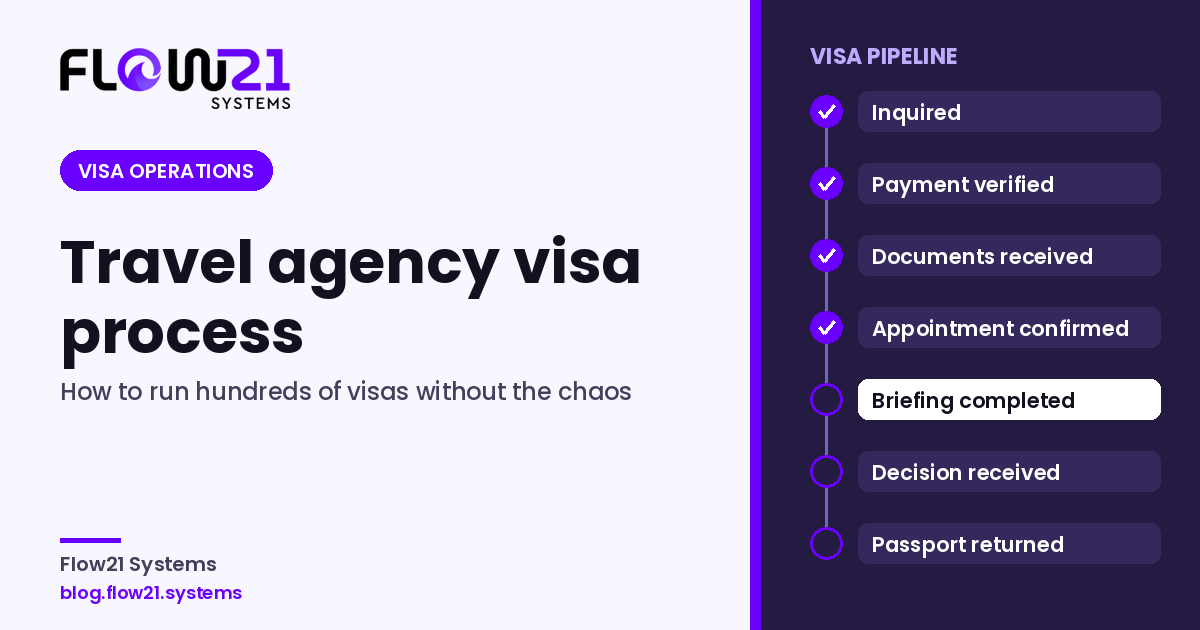
Here is the visa lifecycle we put together from building visa pipelines with Flow21 clients. Stage names are in the past tense, so a card’s position shows what is already done. Not every case uses every stage.
- Inquired. A chat keyword, QR code, web form, or a visa tag added to a travel deal. Watch for unassigned leads.
- Rate sheet and requirements sent. Requirements depend on the visa type and the client’s source of funds (employed or self-employed). It’s a rate sheet plus a checklist, not a quotation.
- First and second follow-up done. An automated email, then a personal call.
- Payment verified by accounting. Proof of payment uploaded, a receipt number recorded, accounting confirms.
- Initial documents received. Passport bio page and the questionnaire or application form.
- Visa form encoded and application number issued. Data often can’t be edited after this point.
- Appointment scheduled, then confirmed. The client’s preferred date is kept separate from the date the visa center confirms. Biometrics and interview may be two appointments.
- Briefing completed. Interview coaching about two days before, for visas with an interview.
- Final documents received. Complete vs incomplete is tracked, not remembered.
- Travel insurance requested, then issued, where the visa needs it. Insurance validity has to cover the travel dates.
- Courier booked and documents received by the third party, when the physical passport has to travel.
- Personal appearance or biometrics done.
- Third-party statement requested, then paid, if you use a processing partner.
- Awaiting decision.
- Decision received and result sent. Approved or refused, with a short undo delay before the email goes out.
- Passport returned to agency, then returned to client.
- Review requested. Approved clients only.
How do you stop intake mistakes you can’t undo?
Protect intake, because some mistakes can’t be fixed later. With some embassies, once passport details are in their system, they can’t be edited:
“We really need to be sure, because the passport cannot be changed anymore if it has already been entered into their account… The database is already at the embassy.”
— Flow21 client, travel agency
Passport details often arrive as a blurry photo or a tiny screenshot in chat. And while processors wait on the client, they sometimes enter placeholder data to keep moving. That is how a placeholder ends up in a final submission. Agencies that handle this well:
- Ask for a clear, high-resolution photo of the passport bio page instead of a typed number.
- Use the same placeholder text every time, so someone can search for it before anything is submitted.
- Make certain fields required before a case can move on. No application number, no next stage.
- Add a “please double-check your passport details” confirmation on the client form.
Watch for the new-passport trap. A client gets the visa, then renews their passport without telling you. The visa is still in the old passport. One Flow21 client told us that in a recent case, even the visa center didn’t know about the new passport. The fix: ask at intake whether the client plans to renew before travel, add a required acknowledgment that they will keep the old passport with the visa and bring both, and repeat that reminder in the visa-grant email.
Screen for eligibility before you take payment. Check that the passport is valid for at least six months, and ask whether this visa requires another visa the client should already hold.
Should a family share one visa application record?
No. A family is several applications, even if they share one appointment, one flight and one group chat. Each person has their own form, documents, appointment record and decision.
“Usually they apply three or five together, like that. So we add them individually.”
— Flow21 client, travel agency
If the whole family is one card, you can’t see who is still missing documents or who was refused. So use one applicant, one record. Link family members with a shared group or family tag and a note naming the lead applicant. If your forms auto-fill for returning contacts, turn that off on shared devices and for repeat families, so one person’s form doesn’t land on a sibling’s record.
Keeping one contact with several opportunities also keeps the history together for repeat clients. At one Flow21 client, some clients come back again and again. For more on that, see travel agency repeat clients and referrals.
How should a travel agency keep visa clients updated?
Send anything critical by email and use chat as the nudge. Clients live in chat:
“Usually they check updates in the group chat or on [chat].”
— Flow21 client, travel agency
But chat is not a channel you can count on for critical updates. Social messaging platforms limit when you can send automated follow-ups once a client has gone quiet, and long messages can fail. We cover those limits in the 7-day messaging window for travel agencies.
What works:
- Send appointment confirmations, missing-document requests and results by email, from the agency’s own domain so they don’t land in spam.
- Use chat to say “please check your email.”
- Split long requirement messages into short parts.
- Send one expectation-setting email when the application is lodged: the usual wait for this visa, when you will check in, and what you might still need.
- For electronic travel authorizations whose result goes straight to the client’s email, ask the client for a screenshot so you can check for typos.
- Move client group chats off staff members’ personal accounts. If a processor leaves, the client history shouldn’t leave with them.
Decisions can take a few hours, 10 to 15 working days, or two weeks to two months, depending on the visa. Without these updates, your team spends that wait answering “Is my visa out yet?” by hand.
Why should the interview briefing be its own stage?
Because it’s the step clients value most, and most agencies don’t track it anywhere:
“We give them an update during the briefing two days before their appointment, so they don’t forget what possible answers they can give during the interview. That is the highlight of the briefing.”
— Flow21 client, travel agency
When the briefing lives in a group chat and a processor is on leave that week, someone just doesn’t get briefed. Book the briefing as its own calendar event tied to the interview date. Add a “briefing completed: yes or no” field and flag it red if it’s still blank close to the interview.
How do you protect your approval rate and reputation?
Handle approvals and refusals differently. Approvals are your best marketing. One Flow21 client asks approved clients for a selfie for documentation and, with consent, social proof. Refusals need care:
“What happened to us, why was it declined? So of course, when it’s declined, that’s the biggest problem.”
— Travel agency that we spoke to
Two rules: refused clients never get a review request, and the status email goes out after a short delay of a few minutes, so a wrong status can be fixed before the client sees it. For refusals, log the reason and offer next steps, such as reapplying.
How should a travel agency track visa payments?
Make “payment verified” a stage that must be cleared before anyone books an appointment. In visa work, money moves in several steps. The client pays you, in full or in parts. You pay the visa fee. You may pay a third-party processor. Prime-time slots can cost extra, and cancellations bring refunds.
“I cannot schedule an appointment unless I have paid them, because I also need to pay them the visa fee.”
— Flow21 client, travel agency
If someone books before the client’s payment clears, the agency pays out of pocket. So:
- Have the client upload proof of payment, and notify accounting automatically.
- Flag the case “please check payment” if an appointment is booked before payment shows up.
- Track the third-party payable as its own pair of stages: statement requested, statement paid.
- Notify the finance owner when a refund is being processed.
Our post on staged payment tracking goes deeper on payments that arrive in parts. And if clients say yes but don’t pay, read verbal yes, no deposit.
Should you have one visa pipeline or one per visa type?
One per high-volume visa type. Every visa type has its own rules. Some need biometrics and an interview as separate appointments. Some are biometrics only. Some renewals skip the appointment. Some need insurance that covers the exact travel dates. One online form runs to 17 pages. Some require a medical exam for older applicants, and some have rules that change outside your control:
“We do not control the visa process.”
— Travel agency that we spoke to
Put all of that in one pipeline and nobody knows what step anyone is in. After a Flow21 client split into separate pipelines, they told us:
“Yes, much better… Must organize. What step are we in…”
— Flow21 client, travel agency
A few details make it work:
- Name each pipeline after the visa type, not just “Visa.” One client pointed out staff could mistake a plain “Visa” pipeline for passport applications.
- Use past-tense stage names like “Documents received” and “Briefing completed.”
- Color stages by who moves them, the client or the staff, or automated vs manual.
- Use conditional stages, like “Medical exam set,” only for the cases that need them.
- Red-flag anything with no owner. Our travel agency inquiry triage post covers routing new inquiries.
How do you stop answering “What are the requirements?” all day?
Use keyword auto-replies. When a client types a visa type, they get the right checklist and form link automatically. One Flow21 client’s reaction:
“I like this one. Automated response for as long as you mentioned keywords.”
— Flow21 client, travel agency
Many visa applicants are older and prefer not to fill in long online forms. So keep a file-upload or PDF route, a QR code to the form for walk-ins, and staff-assisted encoding alongside the online form.
How do you get a new visa system to stick?
Start with something workable and tune it with the people who use it. One Flow21 client holds a weekly “visa clinic” call to adjust automations. A separate test pipeline keeps experiments away from live cases. No automation is perfect on day one, and the team’s feedback is what makes it reliable.
FAQ
What is a travel agency visa process?
It is the set of steps an agency runs for each applicant, from inquiry and requirements to payment, documents, appointment, briefing, decision, passport return and review. It often runs to 15 to 25 steps, and outside parties control about half of them.
How many stages should a visa pipeline have?
Enough to show where every case is. The lifecycle we built with Flow21 clients has about 17 stages, with some used only for certain visa types or cases.
Should each family member have their own visa record?
Yes. Each applicant has their own form, documents and decision. Link family members with a shared tag and a note naming the lead applicant.
Should visa updates go by chat or email?
Send critical updates by email from your own domain, and use chat as a nudge to check it. Messaging platforms limit automated follow-ups.
When should a visa appointment be booked?
After the client’s payment has been verified, so the agency isn’t paying the visa fee out of pocket. Flag any appointment booked before payment shows up.
Should refused applicants get a review request?
No. Leave refused clients out of review requests, log the refusal reason, and offer next steps.
Want this built for your agency?
This is what Flow21 builds. The Travel Sales Flow System includes visa pipelines built around these steps, connected to your travel pipeline, with one record per applicant. We build it with your team and fine-tune it every week with the people who use it. Book a demo or get your free build, then try it with a 7-day free trial. Or chat with us about where your visa cases get stuck.