What Should a CRM for a Small Travel Agency in Australia Do? A Guide for Sole Traders
By Ian Denver Sanchez, cofounder of Flow21 Systems (Sales and Marketing Systems for Travel Businesses)
A CRM for a small travel agency in Australia should keep every enquiry, client and follow-up in one place, remind you what is due before and after each trip, and take data entry off your plate. For a sole trader or two-person travel agency, the right CRM runs even when you’re busy or travelling.
Key takeaways
- A small travel agency needs fewer features, not more. It needs the few that run without the owner pushing every button.
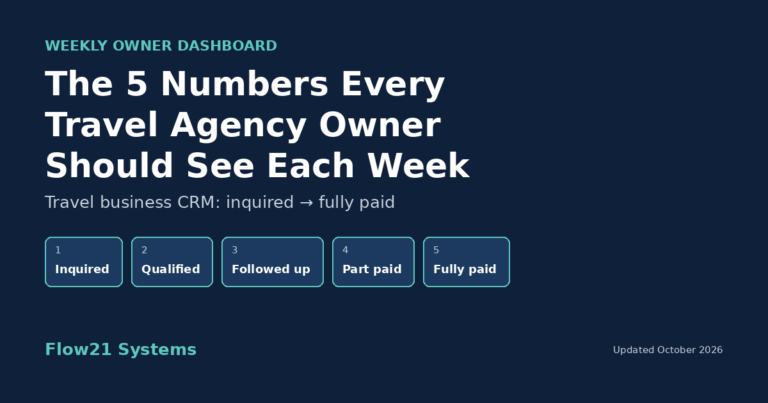
- The five jobs that matter: capture every enquiry, one client record, trip-stage follow-ups, after-trip contact, and easy contact import.
- Many small owners already have a CRM and don’t use it. Setup and upkeep, not the software, are usually the gap.
- Harvard Business Review cites CIO magazine: around one-third of CRM projects fail, with analyst estimates from 18% to 69% (December 2018).
- Ask about exit rules before you sign: lock-ins and whether you can download your data.
Flow21 is a done-for-you CRM and sales system built only for travel agencies and tour operators. This guide is for independent travel agents in Australia who work under a host agency, sole traders and very small travel agency owners. If you searched for a travel agent CRM in Australia, this is the checklist we would use.
What is a CRM for a small travel agency?
A CRM for a small travel agency is one shared record of every enquiry, client, trip and follow-up, so nothing depends on the owner’s memory. CRM stands for customer relationship management. In a travel agency, it tracks people from first message to welcome-back.
A booking platform is different. If you work under a host agency, its platform handles reservations and supplier bookings. The CRM handles the relationship around the booking: who asked, what you sent, what is due next, and who to contact after the trip. A solo travel agent in Australia we spoke to put the gap plainly:
“Most independent travel agents have a host company, so we use their booking platform… but we run as an independent travel agent. So we need require all this help”
— Travel agent that we spoke to
Why do small travel agencies give up on their CRM?
Small travel agencies give up on their CRM because nobody has time to set it up properly and keep it running. The owner buys it, learns half of it alone, and goes back to chat threads and notes. The software isn’t wrong. It just never got finished.
“I’m not very good with this, which is why I’m struggling. I’m not using it to its full potential because I’m mostly self taught”
— Travel agent that we spoke to
This is a common story. Harvard Business Review reports: “In 2017, CIO magazine reported that around one-third of all customer relationship management (CRM) projects fail. That was actually an average of a dozen analyst reports. The numbers ranged from 18% to 69%.” (Harvard Business Review, December 2018). For a one-person travel agency, there is no IT team to fix that. The owner is the IT team.
Which features does a small travel agency CRM actually need?
A small travel agency CRM needs five features: enquiry capture from your chat channels, one record per client, follow-up reminders tied to trip stages, after-trip contact, and easy contact import. Anything beyond that is optional until those five run on their own.
| Feature | Why a small travel agency needs it | Sign it’s missing |
|---|---|---|
| Enquiry capture | Messages from Facebook, Instagram and email land in one list | You search chats for who asked |
| One client record | Trips, notes and suppliers in one place | Details live in your head |
| Trip-stage follow-ups | Reminders before departure, including final documents | You chase from memory |
| After-trip contact | Welcome back and review request | Past clients go quiet |
| Contact import | Event and supplier contacts in without retyping | A pile waits to be entered |
The last row is where many solo owners lose a week: after any networking event, every new contact has to be typed in and matched by hand.
If entering data takes longer than the meeting did, the CRM is working for you only on paper.
How should a small travel agency CRM handle follow-ups?
A small travel agency CRM should handle follow-ups by trip stage, not by memory. Each booking gets the same steps: reply, quote, confirm, remind, send final documents before departure, then welcome back and ask for a review. The CRM shows what’s due today, on Sydney time or whatever time zone you work in.
“there’s a whole lot of follow up that needs to be done till the time they leave… the final documents sent to them just 48 hours before.”
— Travel agent that we spoke to
“I’m constantly chasing people. I don’t know what am I chasing?”
— Travel agent that we spoke to
The fix for “I don’t know what am I chasing” is a single list of open follow-ups with a due date on each. Our travel agency follow-up system guide lays out a schedule you can copy, and our full travel agency CRM system guide shows how follow-ups fit into the whole pipeline.
- Before the trip: confirmation, payment reminders recorded on the deal, final documents.
- During the trip: nothing unless the client needs you.
- After the trip: welcome back, review request, and a note for their next trip.
Should a solo travel agent set up the CRM alone or get it done for her?
A solo travel agent should set up the CRM alone only if she enjoys software and has spare hours. Most don’t. A done-for-you build means someone else configures the pipeline, follow-ups and imports, and she learns to run it instead of build it.
| DIY CRM | Done-for-you CRM | |
|---|---|---|
| Who sets it up | You, after hours | A setup team |
| Time to working | Whenever you finish | After the build |
| Follow-up rules | You design them | Built in for travel |
| Help after setup | Help articles | A dedicated person |
| Best for | Owners who like software | Owners short on hours |
In this video, Ian Denver Sanchez compares DIY and done-for-you travel agency CRMs, starting at the DIY vs done-for-you section:
Summary: the video walks through what a travel agency has to build itself with DIY software versus what a done-for-you setup includes. Jump to 1:25, 4:08 or 6:23.
Want the done-for-you version? Flow21 builds it free before your 7-day trial starts.
Or chat with us: the chat window is on the page.
What questions should a small travel agency ask before choosing a CRM?
A small travel agency should ask five questions before choosing a CRM: who sets it up, who helps after setup, is it built for travel, how do I import contacts, and what are the exit rules. The last one matters most for a first-time buyer.
- Who builds the pipeline and follow-ups, and how long until it works?
- Who do I call after setup, a help page or a person?
- Is it built for travel agencies, or a general sales tool I have to adapt?
- How do event and supplier contacts get in without retyping?
- Are there lock-ins, and can I download my data if I leave?
The travel agent we spoke to asked the exit question directly:
“if things go topsy turvy, what are the exit rules?”
— Travel agent that we spoke to
With Flow21, the answer is no lock-ins, and you can download your data.
How does Flow21 work for a small travel agency?
Flow21 works for a small travel agency by building the CRM for you, then training you on it during a 7-day free trial. Flow21 builds your Travel Sales Flow System: the pipeline, follow-ups and handoffs, set up only for travel.
- Free build before the trial starts.
- 7-day free trial with 3 onboarding sessions of about 40 minutes each.
- Day 8 is decision day.
- A dedicated person after onboarding, so you aren’t left alone with the software.
- Travel only: Flow21 works only with travel agencies and tour operators.
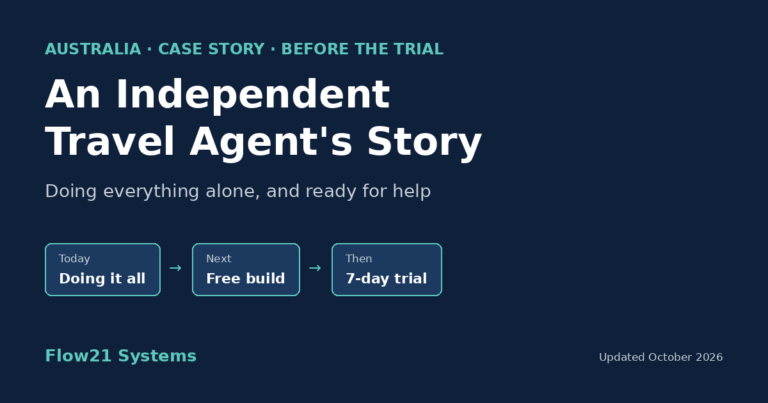
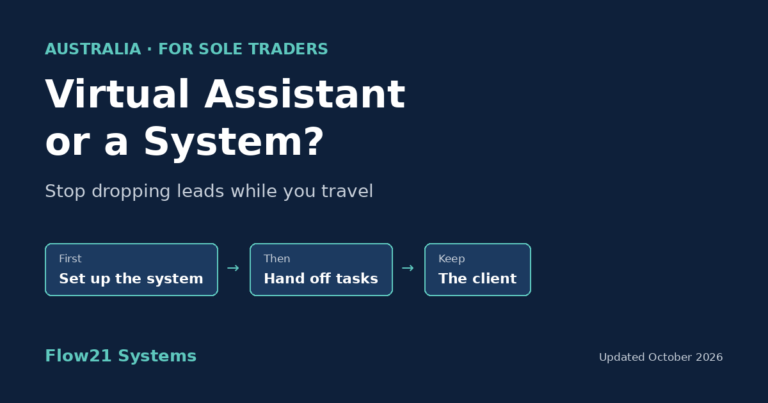
Flow21 doesn’t run your ads and doesn’t promise leads. It organises and follows up the enquiries you already get. Read one solo owner’s starting point in our independent travel agent case story, and how a virtual assistant for travel agents compares with a done-for-you system.
CRM for a small travel agency: frequently asked questions
What is the best CRM for a small travel agency in Australia?
The best CRM for a small travel agency in Australia is the one that actually runs every day: it captures enquiries, keeps one client record, reminds you of trip-stage follow-ups and imports contacts easily. For a solo owner, setup and support matter more than the feature list.
Do I need a CRM if I use my host agency’s booking platform?
Yes, most independent travel agents still need a CRM. The host agency’s booking platform handles reservations; a CRM for a small travel agency handles enquiries, follow-ups and after-trip contact.
Why do small travel agencies stop using their CRM?
Small travel agencies stop using their CRM because no one has time to set it up and keep it updated. Harvard Business Review cites CIO magazine estimates that around one-third of CRM projects fail, with a range of 18% to 69%.
How long does Flow21 take to set up for a small travel agency?
Flow21 builds the CRM free before the trial. The small travel agency then runs a 7-day free trial with 3 onboarding sessions of about 40 minutes each, and Day 8 is decision day.
Can I leave Flow21 and keep my data?
Yes. Flow21 has no lock-ins, and a small travel agency can download its data if it leaves.
Ready for a CRM that runs without you pushing every button?
Book a call and we’ll show you the free build for a small travel agency.
Or chat with us: the chat window is on the page.