16 Departures, One Pipeline: Travel Agency Follow-up System for Group Tours
By Ian Denver Sanchez, former COO of foodpanda Philippines with ₱1 billion (US$21 million) in revenue responsibility, who now runs Flow21 Systems · Updated October 2026
A travel agency follow-up system for group departures has one job: tag every inquiry to a specific departure date, keep payment stages on that same record, and show the owner how many people are interested in each tour — even when 10 or 16 fixed-date trips sell at once across Facebook, Viber and email.
Flow21 is a done-for-you CRM and sales system for Philippine travel agencies and tour operators with 3–15 staff. This post is for owners and marketing leads of Philippine pilgrimage and church-group operators who run several departures at the same time. If you only sell FIT leisure packages one guest at a time, or you want a free tool to build yourself, this isn’t written for you.
Key takeaways
- A departure tag is a label on each deal that says which fixed-date tour the guest wants. Make it required, or mark the guest “date undecided” so they still get chased.
- Keep payment stages, companions and documents on that same guest record. Each payment is recorded on the deal.
- Give the owner a dashboard per departure instead of asking each coordinator.
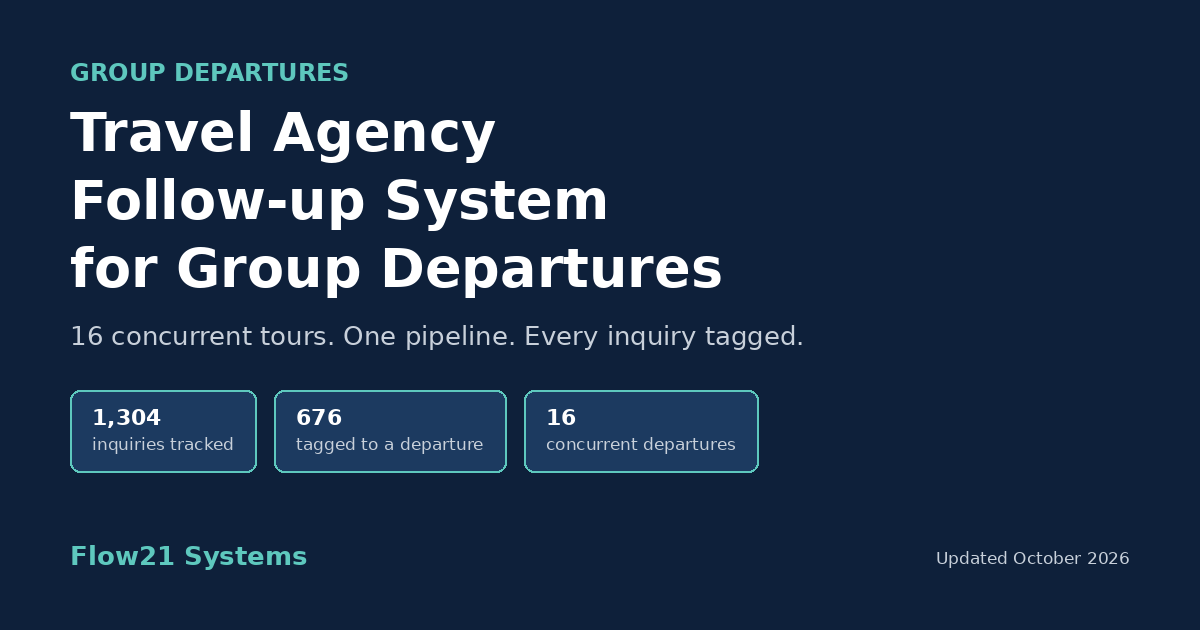
- Proof: one Philippine pilgrimage tour company tracked 1,304 inquiries as deals from Jul 24 to Oct 7, 2026. 676 were tagged to a specific departure across 16 concurrent departures.
“Everything is scattered. Inquiries are on different platforms.”
Group-departure travel agency
When Holy Land trips, Marian shrines and parish groups open for sale together, that scatter gets worse. Coordinators keep their own sheets. Nobody can say, in one glance, how many people are warm for which departure.
Why do group-departure inquiries fall through the cracks?
Group-departure inquiries fall through the cracks because each channel and each coordinator becomes its own mini-system, so warm guests sit unanswered while another departure fills.
A marketing VP at a pilgrimage tour company put the before state in two lines: “There’s no central tracking.” And: “There are inquiries falling through the cracks.”
After they moved to one pipeline, the same company tracked 1,304 inquiries as deals from Jul 24 to Oct 7, 2026 (553 in September). Of those, 676 were tagged to a specific departure across 16 concurrent departures. That is the gap: from “falling through the cracks” to every inquiry visible against a tour date.
For a group-departure travel agency, the cost of scatter is specific. If a guest isn’t tagged to a departure, nobody chases them for it. A guest who asked about the October Holy Land slot may still be interested in November. Without a departure tag, that guest is just another unread chat.
Speed matters here too. In a study of 1.25 million sales leads published in Harvard Business Review, firms that tried to reach a lead within an hour were nearly seven times as likely to have a meaningful conversation with the decision maker as firms that waited even an hour longer. An untagged inquiry is usually a slow one.
| What breaks | Sheets + Messenger | One departure-tagged pipeline |
|---|---|---|
| Where inquiries live | Facebook, Viber, email, personal phones | One pipeline, every channel |
| Which tour they want | Remembered by the coordinator — or forgotten | Tagged to a specific departure |
| Payment stage | Separate spreadsheet, often late | On the same guest record |
| Companions and documents | Scattered notes and group chats | On the same record |
| Owner view | “Ask the team” | Dashboard per departure |
What does a travel agency follow-up system do for fixed-date tours?
A travel agency follow-up system turns every inquiry into a deal tied to a departure, with a next follow-up date and a payment stage the whole team can see.
Agencies like yours are aiming for 6 group departures of 30–40 pax. When those departures overlap, follow-up is not “send a reminder sometime.” It is “who still owes a downpayment on the December Marian shrine trip, and who has companions but no passport scan yet?”
A working travel agency follow-up system for group tours does four things every day:
- Captures Facebook, Viber and email inquiries into one place with one owner.
- Tags the guest to a specific departure (or parks them as “date undecided” so they still get chased).
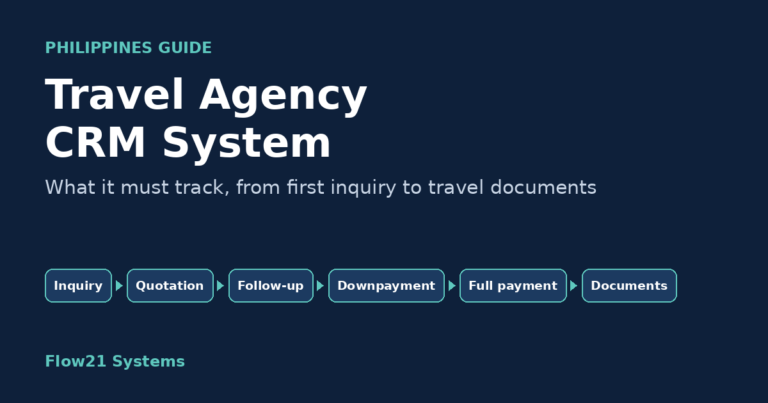
- Moves the deal through payment stages on that same record — inquiry, quotation, downpayment, balance, documents.
- Shows the manager a dashboard per departure, not a pile of unread chats.
Here’s a short walkthrough of how follow-up stages work when a guest moves from first reply toward payment:
Want this built around how your departures actually sell? Chat with us: tap the chat button at the bottom of this page and tell us how many fixed-date tours you run at once. We’ll build your system free first, then your team tries it for 7 days.
How do you keep 16 concurrent departures in one pipeline?
You keep 16 concurrent departures in one pipeline by making the departure a required tag on every deal, so capacity and follow-up are visible per tour without 16 separate spreadsheets.
A Philippine pilgrimage tour company runs its departures this way. Before: no central tracking. After: one pipeline, every deal tagged to a departure when the guest picks one.
The process is simple enough that staff stick with it:
- Every new inquiry becomes a deal the same day it arrives.
- The first question after name and contact is which departure — or “still choosing.”
- Follow-up tasks sit on that deal, not in a personal reminder app.
- When a guest switches dates, you retag the departure; you don’t start a new sheet.
If your team still loses guests after a verbal yes, read verbal yes, no deposit. If quotations go out and then go quiet, see the follow-up gap after a package quotation.
What belongs on the same guest record for a pilgrimage trip?
Companions, payment proofs, document checklist items and the departure tag belong on the same guest record so any coordinator can pick up the thread without hunting group chats.
Group travel management software that only holds a contact name is not enough. For church-group and pilgrimage sales, the record has to carry:
- Departure date and package (or “undecided”).
- Party size and companion names when they arrive.
- Each payment recorded on the deal, with proof attached.
- Passport, visa and other document items checked off as they come in.
- Who on your team owns the next follow-up.
That is the practical difference between a contact list and a travel agency CRM system built for how group departures actually close.
What did one pilgrimage tour company see after the change?
The pilgrimage tour company saw every inquiry land in one pipeline, about half of them tagged to a specific departure, and a dashboard its management could finally trust.
The numbers: 1,304 inquiries tracked as deals from Jul 24 to Oct 7, 2026; 553 in September; 676 tagged to a specific departure across 16 concurrent departures. No revenue claim. No booking claim. Just visibility that did not exist before.
“The AI bot is helping. Yeah, it’s helping a lot.”
Pilgrimage tour company
“I want to continue using it.”
Pilgrimage tour company, during onboarding
“The system is also very easy to understand, easy to grasp.”
Pilgrimage tour company, during onboarding
“We have a very powerful dashboard. So even our management was very excited.”
Pilgrimage tour company, during onboarding
Flow21 builds the pipeline for your departures, trains your coordinators, and stays until the dashboard is the place your team actually works.
Is group departure management different from FIT leisure sales?
Yes — fixed departure dates, shared capacity and multi-pax companion records make group departure management for travel agencies a different job than one-off FIT leisure sales. Group departure management is selling several fixed-date tours at once, each with its own capacity, payment stages and document checklist.
In FIT, you can often live with a simple inquiry-to-payment pipeline. In group tours, the same guest may switch dates twice, bring three companions, and need documents chased for months before wheels-up. Pilgrimage tour operator CRM needs are really departure CRM needs: capacity per date, stage per guest, and one owner view across every open tour.
That is also why a generic sales tool fails here. It was not designed for “16 tours live, guests hopping between them, payments in stages, documents on the same card.”
Who is a travel agency follow-up system a fit for — and who isn’t?
A travel agency follow-up system fits owners running several fixed-date group departures with a small team. It is not a fit for solo agents or teams whose real problem is generating first inquiries.
It fits if:
- You sell pilgrimage, church-group or other fixed-date tours with several departures open at once.
- You have 3 to 15 staff besides the owner, and more than one person answers Facebook, Viber or email.
- You cannot say today how many warm guests sit on each upcoming departure.
It is not a fit if you sell alone, if you want a cheap tool to configure yourself, or if you barely get inquiries yet. We don’t run your ads. We make sure the inquiries you already get are tagged, followed up and tracked to payment. To see the full stage checklist from first message to travel documents, start with our travel agency CRM page.
Frequently asked questions
What is a travel agency follow-up system for group departures?
It is one pipeline where every inquiry is captured, tagged to a departure, given an owner and moved through payment and document stages. The owner can see interest and progress per tour without asking each coordinator.
How is group travel management software different from a contact list?
A contact list stores names. Group travel management software for travel agencies must also store the departure tag, companions, staged payments and document checklist on the same record so handoffs don’t drop the guest.
Can AI handle the first reply on Facebook and Viber?
Yes, AI can handle the first reply and basic package questions on Facebook and Viber, using your own itinerary information. Prices, availability and final quotations stay with your team, because AI can get details wrong.
Will coordinators actually use a pilgrimage tour operator CRM?
Coordinators will use a pilgrimage tour operator CRM if the pipeline matches how they already sell and someone trains them. One pilgrimage tour company told us during onboarding that the system was “very easy to understand, easy to grasp,” and that management got excited about the dashboard.
How many departures can one pipeline handle?
One pipeline can handle as many departures as you sell at once, as long as every deal is tagged. One Philippine pilgrimage tour company ran 16 concurrent departures in one pipeline, with 676 inquiries tagged to a specific tour between Jul 24 and Oct 7, 2026.
How do we try Flow21?
Flow21 builds your system free. Your team then runs a 7-day free trial on it, and you decide on Day 8. After payment there is a 30-day money-back guarantee. Onboarding slots are limited each week. To start, chat with us.
The bottom line
A travel agency follow-up system earns its place when every group inquiry is tagged to a departure, payments and documents live on that record, and the owner can see 10 or 16 live tours without opening five spreadsheets. Sheets and memory work until they don’t. One pipeline is how you stop losing the guests who already raised their hand.
Chat with us: tap the chat button at the bottom of this page and tell us how many fixed-date departures you run right now. We’ll show you what your free build would look like.