Travel Agency SaaS vs a Done-For-You System: Which Should Your Travel Agency Choose?
By Ian Denver Sanchez, cofounder of Flow21 Systems (Sales and Marketing Systems for Travel Businesses)
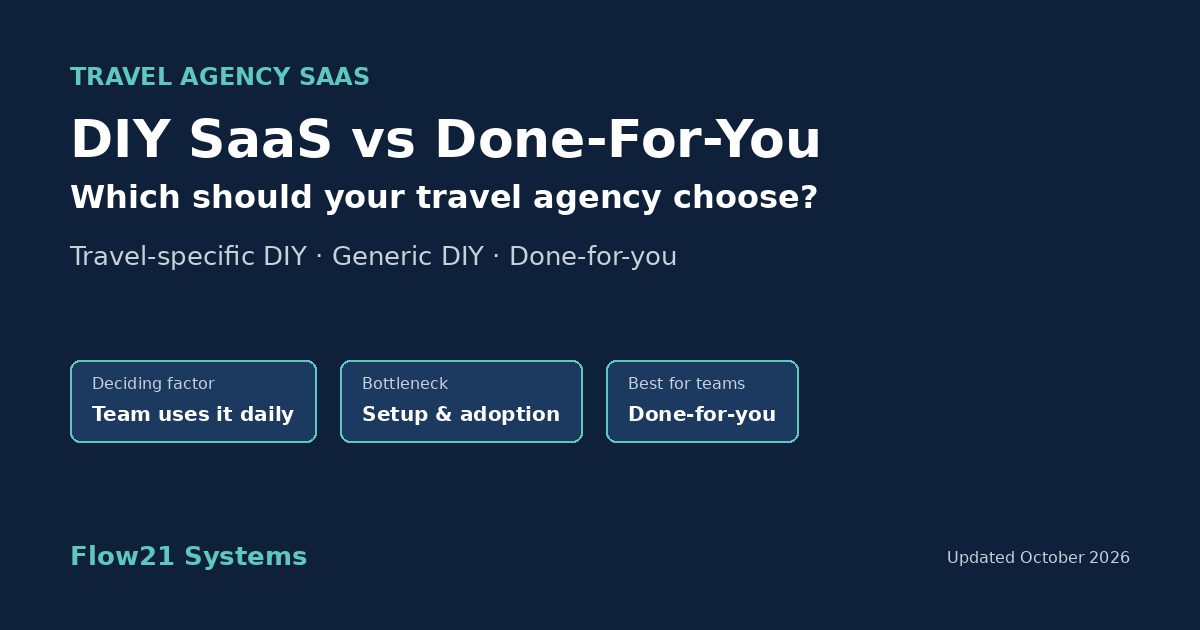
Travel agency SaaS vs a done-for-you system: which should your travel agency choose? Travel agency SaaS usually means three things: a travel-specific DIY tool, a generic DIY CRM, or a done-for-you system. The winner is the one your team actually uses every day on every inquiry. For most travel agencies with three or more staff, that is usually done-for-you.
Flow21 is a done-for-you CRM and sales system built only for travel agencies and tour operators. This post compares the three categories with no vendor names, so you can judge them by setup, adoption and follow-up — not by a feature list.
Key takeaways
- Travel agency SaaS is not one product type: it covers travel-specific DIY tools, generic DIY CRMs, and done-for-you systems.
- The deciding factor is adoption: “It’s the one your team actually uses every day on every inquiry.”
- Setup, adoption and follow-up are the bottleneck — not the software feature list.
- A travel agency CRM must cover eight basics: one inbox, fast reply, qualify by phone, logged quotes, follow-up cadence, payments, trips/departures, and an owner’s view.
- DIY SaaS can suit a solo agent or an owner who enjoys configuring tools. Done-for-you usually fits teams of three or more who need someone to own the rollout.
What is travel agency SaaS?
Travel agency SaaS is software you subscribe to for capturing inquiries, following up guests and managing the path from quote to trip. It is not one category. Owners usually mean one of three things when they say it.
- Travel-specific DIY tools. Built for travel (itineraries, proposals, trips). Your team still sets up the pipeline, automations and habits.
- Generic DIY CRMs. Flexible for any industry. You design the travel stages (inquiry, quote, down payment, balance, fully paid, departure) yourself and keep them running.
- A done-for-you system. A team that knows travel builds it around how your travel agency sells, trains your staff, and stays with you after onboarding.
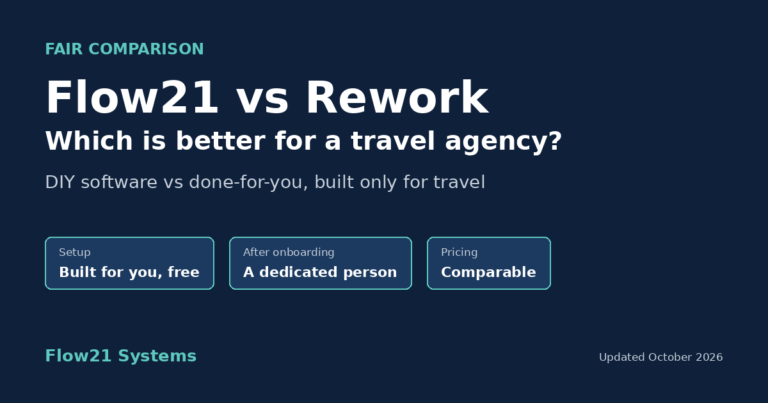
For a named head-to-head with one general-purpose DIY platform, see our Flow21 vs Rework comparison. This post stays at the category level.
Why do travel agencies buy SaaS and end up back in spreadsheets?
Travel agencies buy SaaS and end up back in spreadsheets because the software is rarely the bottleneck. Setup, adoption and follow-up are. Owners describe it like this:
“They gave me an Excel file… so many commands… I don’t have time for this… my staff even find it difficult. So we forgot about that.”
— Travel agency that we spoke to
“Hiring developers… we ended up not using it.”
— Travel agency that we spoke to
“Lots of stitched systems together… only use 1% of its functionality and then we’ve got Google Sheets either side.”
— Tour operator that we spoke to
That pattern is not unique to travel. Harvard Business Review notes that in 2017, CIO magazine reported that around one-third of all CRM projects fail — an average across a dozen analyst reports that ranged from 18% to 69%. When a tool adds a second job nobody applied for, staff quietly go back to chat threads and spreadsheets.
Night inquiries make the cost visible fast:
“Inquiries at night are extremely valuable… Gone. The guest has already inquired with someone else.”
— Tour operator that we spoke to
What must a travel agency CRM do? (8-point checklist)
A travel agency CRM must do eight things before features beyond that matter. Whatever category you choose, use this checklist:
- One inbox. Messenger, Instagram, WhatsApp, email, website and walk-ins land in one place with their source.
- A fast first reply, day or night. Speed protects the inquiry before the guest messages someone else.
- Qualify by phone number. A qualified inquiry is one that gives you a phone number so a person can close.
- Logged quotes. Every quote sits on the lead with who sent it and when.
- Follow-up that does not rely on memory. A working cadence is within 5 minutes, then day 1, 3, 7 and 14.
- Down payment, balance, fully paid. A verbal yes is not a booking. Payments are recorded on the deal.
- Trips and departures. Travel dates, travelers, documents and which departure each booking belongs to.
- The owner’s view. Who is handling each inquiry, what got followed up, and what got paid — without chasing the team.
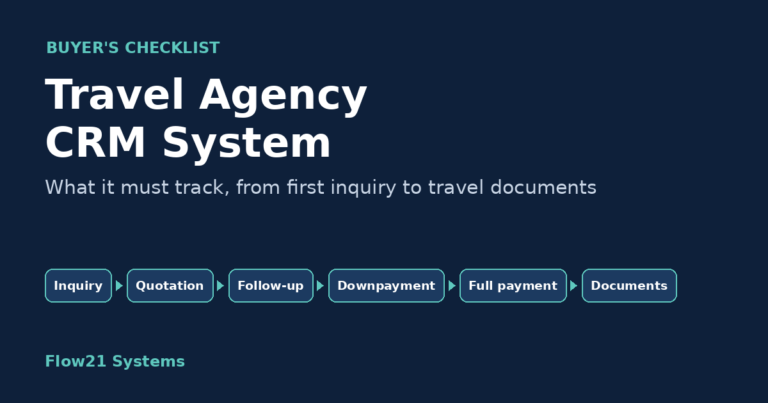
For the full stage-by-stage guide, read our travel agency CRM system pillar.
How do the three categories compare?
The three categories of travel agency SaaS differ most on who owns setup, who builds the travel stages, and who stays after onboarding.
| Travel-specific DIY SaaS | Generic DIY CRM | Done-for-you system | |
|---|---|---|---|
| Setup | You configure it | You design and build it | Built with you, free, before you decide |
| Who builds the travel stages | Your team (travel-shaped tools help) | Your team designs inquiry → paid → trip | A travel-only team builds them with you |
| Staff adoption | You train and enforce habits | You train and enforce habits | Staff join onboarding; someone owns rollout |
| After-hours inquiries | You build the reply rules | You build the reply rules | Built around your packages and handoff |
| Support after onboarding | Docs, help desk, community | Docs, help desk, community | A dedicated person stays with your team |
| Fit | Solo agents; owners who like configuring tools | Ops-minded owners with time to build | Travel agencies with 3+ staff and no time to babysit software |
What does DIY vs done-for-you look like on video?
The video below walks through the three categories and the adoption test. Jump to 4:08 for the DIY vs done-for-you split.
- 1:25 Travel agency CRM checklist: 8 must-have features
- 4:08 DIY vs done-for-you: the 2 kinds of travel agency CRM
- 6:23 The real bottleneck: setup, adoption and follow-up
Short version from the video (0:28): the travel agency CRM that wins “is the one your team actually uses every day on every inquiry.” At 6:27: “Setup, adoption, and follow-up are [the bottleneck].”
Want this built around how your travel agency already sells? Book a call to get free trial. Or chat with us — the chat widget is on this page.
What does done-for-you look like in practice?
Done-for-you means someone owns the setup so your team does not get a second job. Flow21 builds the system around your packages, channels and stages, runs 3 onboarding sessions of about 40 minutes across a 7-day free trial (staff join), and treats Day 8 as decision day. After that, a dedicated Flow21 person stays with your team. Flow21 does not run your ads or promise leads.
Here is a short walkthrough of what that looks like in practice. The screens use sample data.
- 2:30 One inbox for text, email, web chat, Facebook messages and Instagram DMs
- 3:27 Pipeline moves deals stage to stage
For a deeper look at what a travel agency CRM must track from inquiry to trip, start with the landing page or the pillar guide linked above.
When is DIY travel agency SaaS the better fit?
DIY travel agency SaaS is the better fit when you are a solo agent, or an owner who enjoys configuring tools and has time to keep them current. Choose DIY when:
- You want polished itineraries and are happy to set up automations yourself.
- You have an operations person who likes building pipelines and training staff.
- You prefer self-serve software you can start the same day and fully control.
That is an honest fit. DIY is not “wrong.” It fails when nobody owns setup and adoption, and the team goes back to Messenger and spreadsheets.
When is a done-for-you system the better fit?
A done-for-you system is the better fit for a travel agency or tour operator with three or more staff, inquiries across chat apps, and no one with time to build and babysit software. Choose done-for-you when:
- You have already bought a tool and watched staff stop using it.
- You need travel stages (inquiry → quote → down payment → fully paid → departure) built in, not designed from scratch.
- You want a dedicated person with your team after onboarding — not DIY software that leaves you alone.
“I’ve been telling them 100 times… they didn’t continue it.”
— Travel agency that we spoke to
If that sounds familiar, the bottleneck is not another login. It is ownership of setup, adoption and follow-up.
Travel agency SaaS FAQs
What is travel agency SaaS?
Travel agency SaaS is software you subscribe to for sales and client management. It usually falls into three categories: travel-specific DIY tools, generic DIY CRMs you configure yourself, and a done-for-you system built only for travel agencies and tour operators.
Is DIY travel agency SaaS bad?
No. DIY travel agency SaaS can suit a solo agent or an owner who enjoys configuring tools. For a travel agency with three or more staff and no one with time to build and babysit the system, done-for-you usually wins on adoption.
What must a travel agency CRM do?
A travel agency CRM should cover eight basics: one inbox, a fast first reply day or night, qualify by phone number, logged quotes, follow-up on a cadence (within 5 minutes, then day 1, 3, 7 and 14), down payment to fully paid, trips and departures, and an owner’s view of who handled what.
Will my staff actually use a done-for-you system?
Adoption is the deciding factor. Flow21 builds the system around how your travel agency already sells, runs 3 onboarding sessions of about 40 minutes during a 7-day free trial with staff joining, and keeps a dedicated person with your team after Day 8.
How is Flow21 different from generic DIY software?
Flow21 is a done-for-you CRM and sales system built only for travel agencies and tour operators. It is not DIY software that leaves you alone after onboarding: a dedicated Flow21 person stays with your team.
What happens during the Flow21 free trial?
Flow21 builds your system free. You get 3 onboarding sessions of about 40 minutes across the 7-day free trial, with staff joining. Day 8 is decision day.
Ready to see a done-for-you system for your travel agency?
Flow21 builds your system free, and you see it working during a 7-day free trial before you decide. Book a call to get free trial, or chat with us if you have a question first.
Or chat with us on our website.